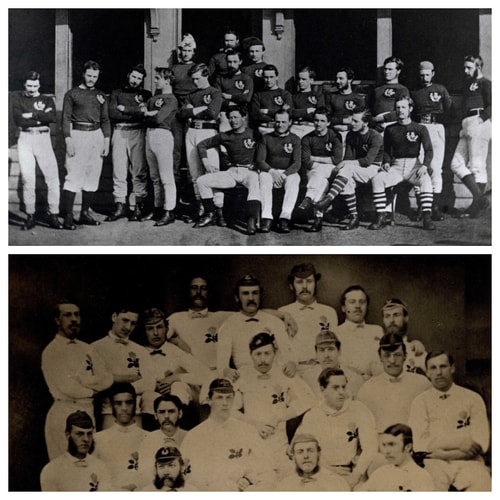
Four teams required six test matches in total. As the series
became regular, it wasn't long before journalists began compiling a
league table to demonstrate which of the sides had had the better
the action and the term 'Home Nations Championship' came into
circulation.
By the mid-1890s, the term 'Triple Crown' was in use to refer to
any team who succeeded in beating all of the others. France joined
in in 1910 and after a period of time the Home Nations Championship
came to be known as the Five Nations Championship. In 1957, England
reached the last round of fixtures having won all of their matches.
The Triple Crown remained a purely British and Irish affair, but
imaginative journalists minted a new concept by describing England
as going for a 'Grand Slam' of victories over all four opponents. A
new accolade was born.
All of these achievements remained purely notional, however,
officially the matches were nothing more than a series of
friendlies. The only trophy available was the Calcutta Cup for the
winners of the England v Scotland match. And even that only made an
appearance at post-match dinners and was never presented to any of
the players, lest too much fuss be made about winning in a sport
where 'taking part' was what really mattered.
Winning certainly mattered to fans though and in the 1970s a
retired Durham miner called Dave Merrington crafted his own Triple
Crown out of a lump of anthracite and campaigned for it to be made
official. Sadly, it wasn't accepted.
By the 1990s, a fresh approach was mounted. Lord Burghesh, the
Duke of Westmoreland, was working with the Victoria & Albert
Museum on an exhibition called 'Sporting Glory' that would showcase
some of the most famous trophies associated with major sports.
Michael J Davies and Associates were appointed as the exhibition
designers and in the course of their research, they discovered that
the Five Nations Championship was the only major sporting event not
to have a trophy. As a showpiece of the exhibition, they set out to
make one. The trophy was designed by James Brent-Ward and
eventually produced by the London Silversmiths- William Comyns.
Sadly, the exhibition was not a success and had to close early.
The new silver trophy was all set to be melted down. However,
Michael Davies, stepped in to prevent this. He believed that the
new trophy had potential and he set about making it official. He
reached out to the Five Nations Committee and his proposal was
viewed favourably by former RFU President Bob Weighill and former
France international Marcel Martin.
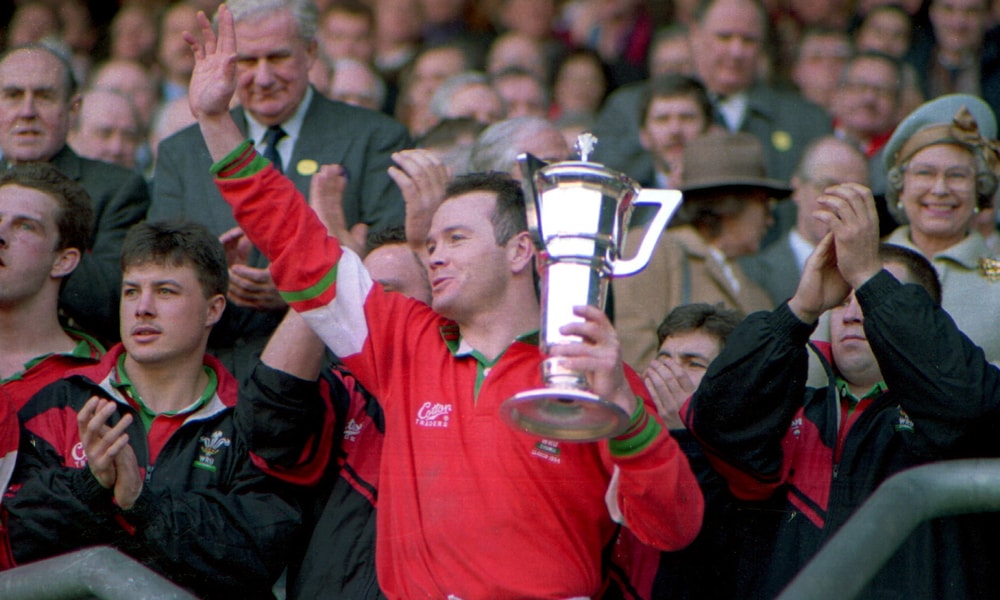
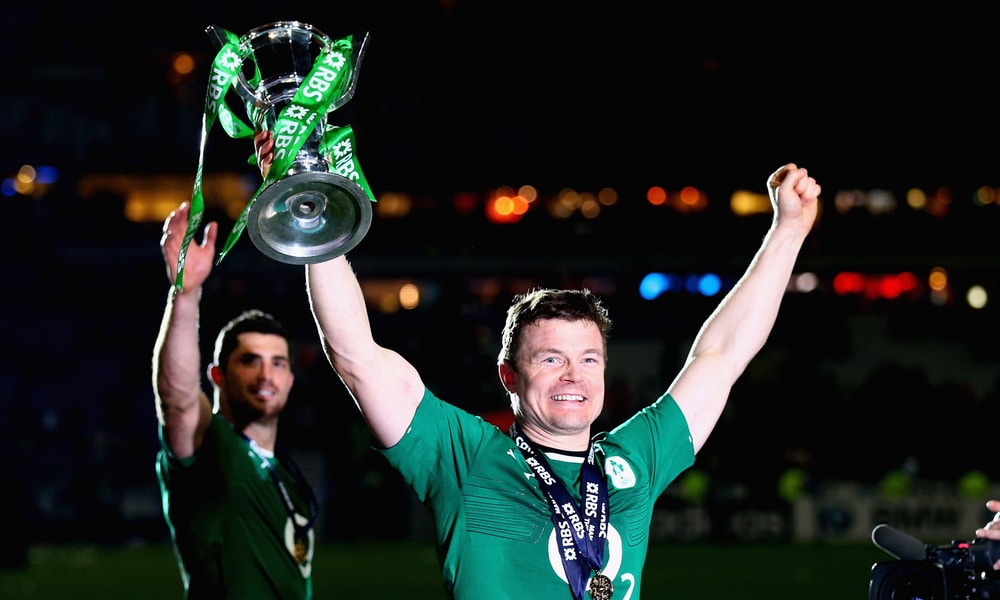
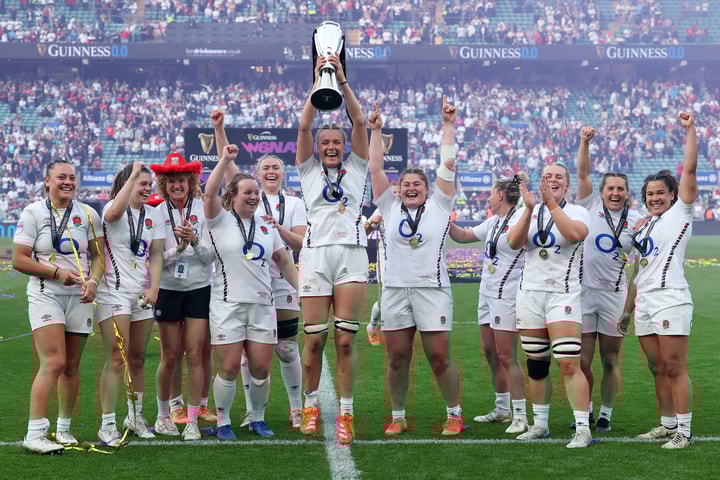
The trophy was thoughtfully designed with fifteen panels, to
represent fifteen players and three handles, to represent the three
officials. Atop the lid sat an interchangeable finial, of which
five (later six) were produced bearing the emblems of the winning
nation. It stood on a five-sided base with silver plaques that
would bear the names of each year's winning team and captain. With
rugby in mind, it had also been designed to hold exactly five
bottles of champagne. Its insides were later lined with gold leaf
to prevent tarnishing.