From The Vaults

01 February 2026
A Beginner’s Guide to the Men's Six Nations

The Men's Six Nations is a Rugby Union tournament played every year between six European rugby-playing nations, namely: England, Scotland, Wales, Ireland, France and Italy. Like so many championships and tournaments, it evolved gradually.


Origins of the tournament

In 1871, the Rugby Football Union (RFU) was formed in England and, within months arranged a match with their Scottish counterparts. Very quickly Ireland (in 1875) and Wales (in 1882) developed national teams, and this gave rise to a series of annual friendlies leading to the Home Nations Championship in 1883. In 1910, France joined to make it the Five Nations, but it was not until 2000 that Italy joined, thus creating the Six Nations, now officially known as the Guinness Men's Six Nations. This is now regarded as the most prestigious Rugby Union tournament in the Northern hemisphere, and its origin makes it the oldest continuous rugby competition in the world.


How does the championship work?

Each of the six sides plays each other once in every season. Matches usually take place from early February to mid-March, with home advantage alternating over two seasons. The competition winners are decided by a league table in which points are awarded for victories, with potential bonus points for tries scored and for narrow defeats. In the event of two or more teams ending with the same number of victory points, a complex assessment of points scored (i.e. tries, penalties etc.) and conceded is used to decide the champions.

Did you know?

Until 1994, there was no system for separating teams with equal victory points, so the Championship could be shared. In 1973, the five countries each won two matches and lost two matches, so they all shared the title!
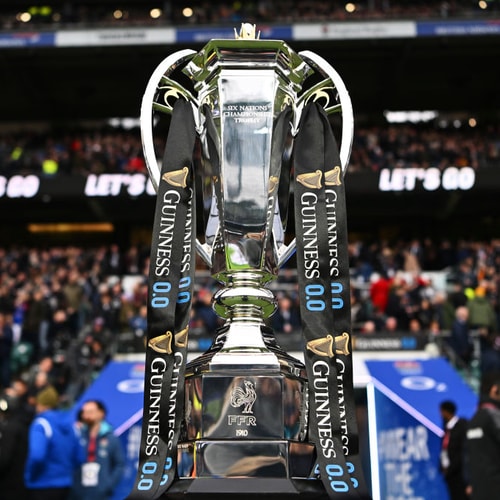
Accolades and Trophies

There are a lot of titles, trophies and accolades up for grabs during the tournament. Here are a few you might hear mentioned during the championship:

A Grand Slam occurs when a team wins all five of its matches in one season.

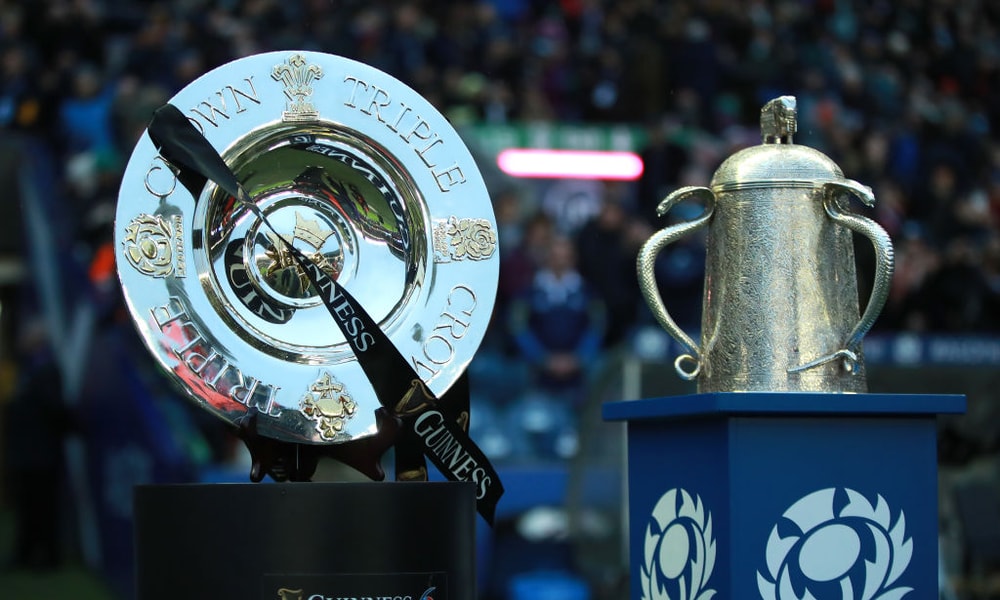
The Triple Crown [pictured left] can only be won by one of the four home unions: England, Wales, Scotland or Ireland. To win it, a team must beat all three of the other home nations. Although the phrase has been used since the late nineteenth century, a physical trophy was not introduced until 2006.

The Calcutta Cup [pictured right] is the oldest trophy, first contested in 1879; it is awarded to the winner of the match between England and Scotland. If this match ends with the score tied, the most recent winner retains the trophy.

The Millennium Trophy is awarded to the winner of the match between England and Ireland. Shaped like a horned Viking helmet, it was introduced in 1988 to celebrate Dublin's millennium.

The Centenary Quaich is given to the victor between Ireland and Scotland. It was introduced in 1989 to mark the centenary of the founding of the International Rugby Football Board (now World Rugby).

The Giuseppe Garibaldi Trophy, introduced in 2007, is contested between Italy and France.

The Auld Alliance Trophy is played between Scotland and France. It was first awarded in 2018, the centenary of the end of the First World War, to commemorate the French and Scottish rugby players who were killed during the conflict.

The Doddie Weir Cup has been contested by Scotland and Wales since 2018, and the Cuttitta Cup by Scotland and Italy since 2022.

which team has had the most success?

Since its inauguration in 2000, the Men's Six Nations has had England and France as champions 7 times each. Ireland and Wales have 6 wins each. Italy and Scotland are yet to win a Men's Six Nations Championship. In 13 of the 26 tournaments, the champions have also completed a Grand Slam - France and Wales 4 times; Ireland 3 times, and England twice.

Prior to 2000, there had initially been the Home Nations Championship from 1883 to 1909 and then the Five Nations Championship from 1910 until 1999. In both competitions there were years when not all teams competed (England in 1888 and 1889; France from 1932 to 1939). Additionally, no matches were played during the First and Second World Wars. Scotland were the most successful of the four nations in the Home Nations Championship. During it's time as a five-nation tournament between 1910 and 1999, England won the most titles outright, closely followed by Wales. France's first success did not come until 1954 when they shared the Championship, though their subsequent record is better than any other nation.


the future of the tournament

Various other European countries, such as Georgia, have growing support for inclusion in the tournament. However, as the overall structure of men's senior rugby has little room for added matches, any change would not be easy to achieve.

match days at Allianz Stadium

The Guinness Men's Six Nations 2026 begins on Thursday 5 February, with France hosting Ireland in Paris.

If you're attending a match at Allianz Stadium, the World Rugby Museum can be visited prior to kick-off.