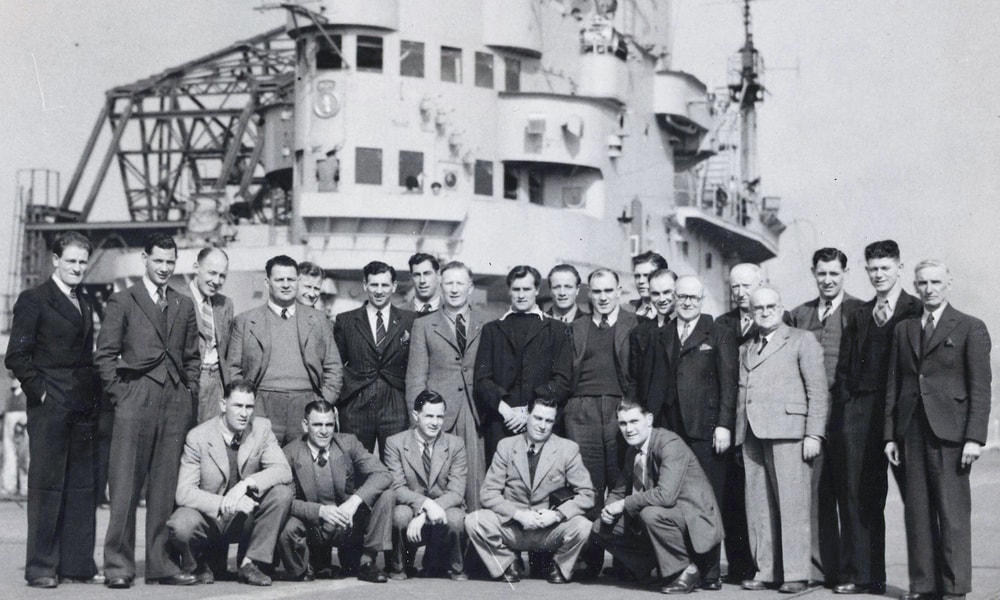
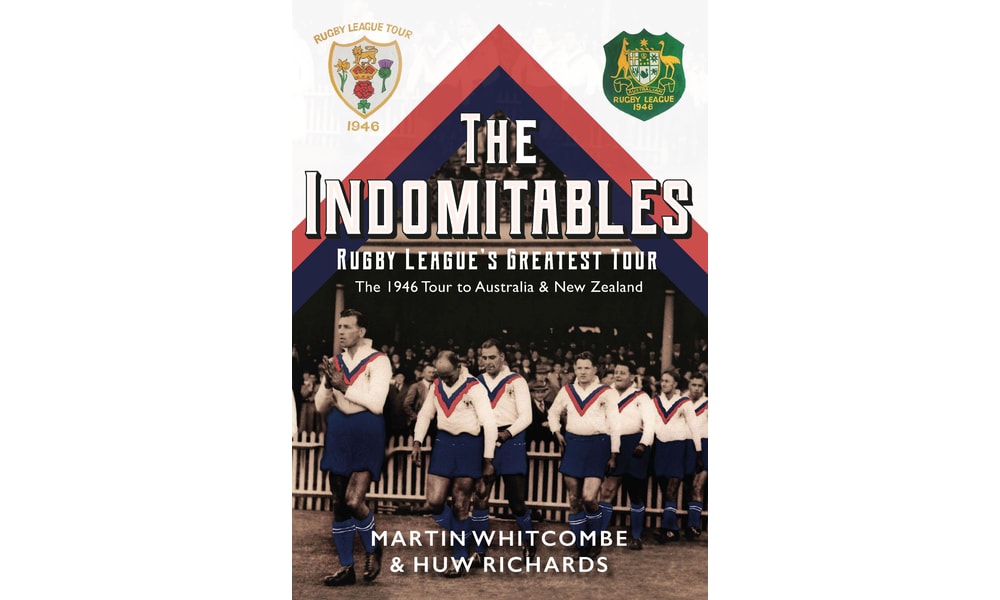
Generally less remarked is that the Indomitables arguably owed
more to rugby union than any other league touring team. Most
British league teams had their share of code-changers, generally
from Wales.
While labelled as England, the Indomitables had record Welsh
representation, 11 out of 26 players including skipper Gus Risman.
Wing Arthur Bassett and outside-half Willie Davies won full Welsh
union caps before the war. Centre Ted Ward, prop Frank Whitcombe,
loose forward Ike Owens, and second rows Doug Phillips and Trevor
Foster had all played in Welsh trials, with Owens progressing to
the full team for the 1940 Red Cross Internationals.
But in 1946 there were also Englishmen who had played union to a
high level under the wartime amnesty for league players in the
armed services.
The best won recognition in the service internationals played
after 1942. Wales inevitably benefitted more. Risman captained
Wales without hell freezing over, learning something of the
idiosyncrasies of 'amateurism' when he billed £4 for expenses and
received £8. He enjoyed himself so much that in the late 1950s he
advised son Bev to delay his inevitable move to league long enough
to play union for England and the Lions.
Loose forward Trevor Foster won the Wales cap for which he had
been disposed to wait in 1939 until Bradford Northern's
representative piled £400 in notes on to the family kitchen table
in Newport. One possible reason why Willie Davies's departure to
league in 1939 was so little resented is that he continued until
1945 to play union for Wales on his home ground, St Helen's,
Swansea which - with the Arms Park and Twickenham both unavailable
- alternated with Gloucester as host of the twice-yearly service
internationals.
Most English league players lacked the pre-war union credentials
of their Welsh counterparts. But nine of them, mostly backs, won
selection for England. Among the Indomitables Bradford Northern's
Ernest Ward had been an automatic England choice, winning 11
services caps - a number exceeded only by ever-present Northampton
prop Ray Longland, future RFU secretary Robin Prescott and Joe
Mycock of Sale. Warrington wing Albert Johnson had played against
Scotland in 1945.
It was only fair that the services tests were not regarded as
full internationals since, excluding civilians, they were not fully
representative. But their quality was unquestionable. Bleddyn
Williams, a wartime prodigy capped as an 18 year old airman, went
on to a memorable Wales and Lions career but to the end of his life
reckoned Wales services the best team he played for.
Nor is there any doubt about the impact of the league players.
Wales beat England seven times in eight meetings between 1942 and
1945. The exception, at Gloucester in 1944, was also the only
occasion when England fielded more league players. Ward kicked four
goals, Johnny Lawrenson of Wigan scored a hat-trick and other tries
were scored by Roy Francis of Barrow - a black Welshman who had
been chosen to play league for Wales and union for England on the
same day in 1943, and regarded the England selection as a military
order - and Ted Sadler of Castleford, 23 points in a 29-6
victory.
Another tourist, Les White of York, had not played union for
England, but had appeared in both of the famed League v Union
matches played in 1943 and 1944. The league teams were more
representative and probably much more motivated, but the fact
remains that they twice defeated union teams including giants like
Wales scrum-half Haydn Tanner playing 15-a-side under union rules.
Ward, Foster, Davies and Owens, all future Indomitables, played in
the second match at Odsal Stadium, Bradford in 1944 while Phillips,
who would shortly sign for Oldham and toured in 1946 after only a
handful of league games, scored for the union XV.
Laying aside the usual inter-code jibes, there is little doubt
that benefits worked both ways. Bleddyn Williams recalled learning
a great deal from league-playing team-mates, not least wing Alan
Edwards's half-joking rebuke after his hat-trick on debut that a
centre was 'supposed to make tries for his winger, not score them
himself'
Similarly league players were given the opportunity to play
union at a high level, a serious contribution to their having much
more serious top-level experience in 1946 than Australian opponents
who had inter-provincial, never mind international, fixtures
suspended for most of the war years.
Union commitments continued into peacetime and the 1945-6
season, not always helpfully to players who found them in conflict
with club fixtures. Risman did not play his final game of union
until March 27th, four days before the tourists set off. Ward,
Phillips and Johnson came near to missing England v Wales, the
most important tour trial, after fulfilling an army fixture in
occupied Germany.
Some league chroniclers may argue that the downside lasted much
longer - citing the deference shown to Twickenham by long-serving
RFL secretary Bill Fallowfield. An autocrat in his own game,
Fallowfield had won two services caps for England under the
captaincy of Prescott, his RFU counterpart from 1963.
There was never any question of the amnesty extending into
peace-time, so league reverted for a further half-century to being
treated like a seceding province rather than a legitimate sport.
But if any doubt remained that each code has something to offer the
other, it was demolished conclusively on another trip to Australia,
in 2003, when Phil Larder's expertise as defence coach and Jason
Robinson's attacking brilliance helped take English union to its
all-time high in that year's World Cup.