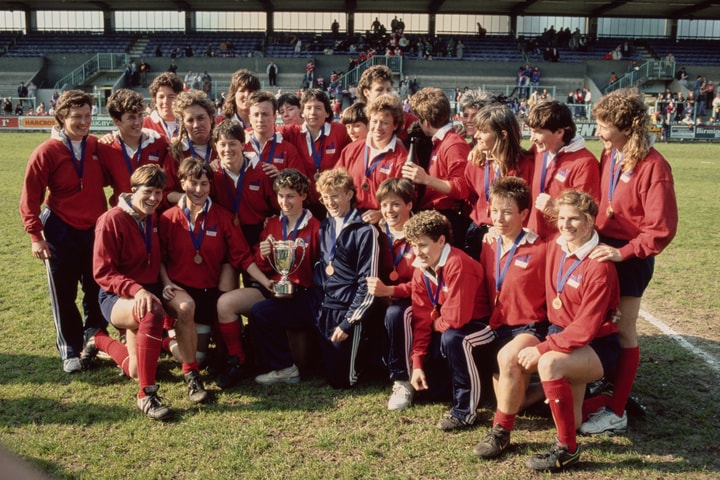
Twelve teams competed at the first women's Rugby World Cup tournament, which took place at venues in and around Cardiff in April 1991. The players were self-funded and many had committed everything to this rare opportunity to prove themselves on the international stage. Behind the scenes, a handful of dedicated volunteers worked tirelessly to bring the tournament to fruition on a shoestring budget.

From The Vaults
14 September 2026
ONLINE EXHIBITION - Pioneers: The First Women's Rugby World Cup

Inspiration
In the years preceding the 1991 Rugby World Cup, two tournaments had proved there was potential for a multi-national women's rugby competition.
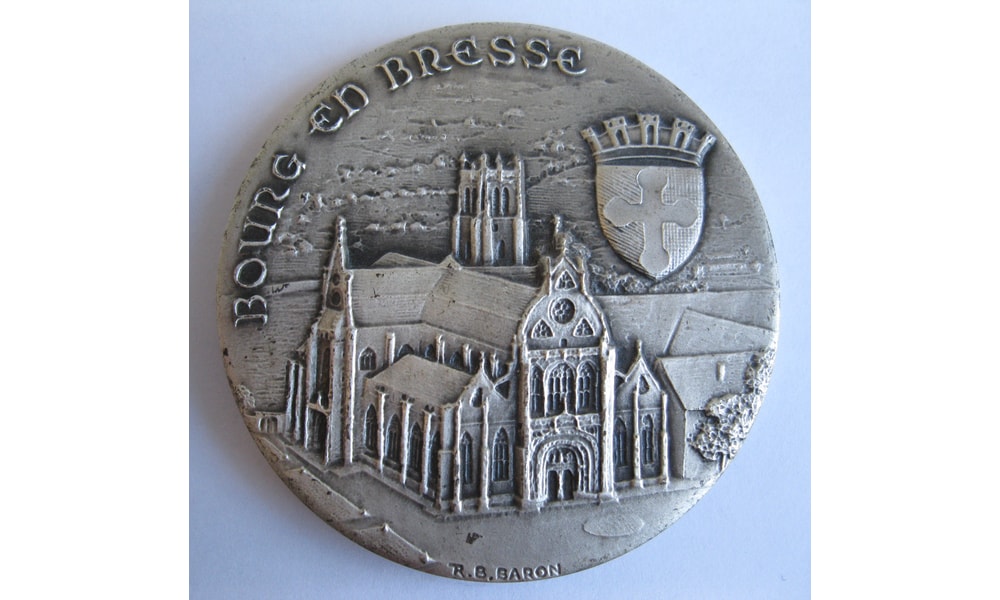
The European Cup, held in France in 1988, had been the first multi-national women's rugby championship, featuring teams from four countries. Following its success, the Women's Rugby Football Union (WRFU) - which ran the women's game in England, Wales and Scotland - agreed that Britain would host the next iteration in 1991.
Another source of inspiration was the Women's Rugby World Festival ("RugbyFest") hosted by New Zealand in 1990. It was a three-tier tournament, with teams representing New Zealand, the Netherlands, the USA and the Soviet Union taking part alongside local regional and club sides. Although no UK clubs could afford to make the trip, it was evident that women's teams were willing to travel to play.
As the WRFU started planning the 1991 European Cup, enquiries began to arrive from teams beyond Europe. There were communications from the national associations responsible for the women's game in the USA, Canada and New Zealand. A global tournament now seemed possible.
Image: Medal, Women's European Cup, 1988
Organising Committee
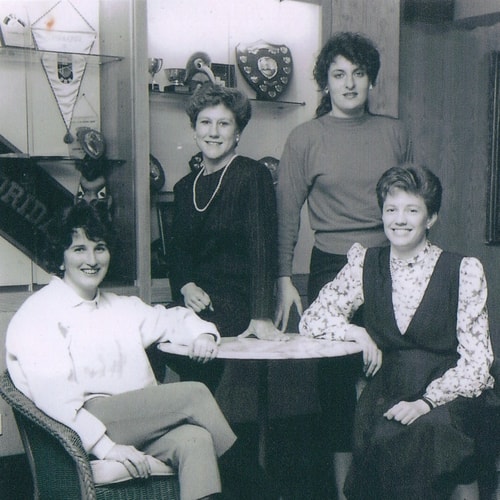
Deborah Griffin started playing rugby as a student at University College London and was instrumental in the growth of the women's game in the UK. An accountant by profession and a player at Richmond FC, she had been a founding member of the WRFU in 1983 and became the driving force behind the tournament after outlining her proposals at a WRFU Committee meeting in January 1990. Griffin was made Chair of the organising committee and she enlisted three Richmond teammates to help. Alice D Cooper, who worked as a copywriter and regularly contributed to Rugby World magazine, was the Press Officer. Mary Forsyth, also an accountant, acted as Treasurer and Sue Dorrington brought fundraising expertise to her role as Commercial Manager.
They met before or after work, giving up several hours each day on top of their full-time employment. Griffin and Forsyth continued working on the project during maternity leave and Griffin's baby daughter ended up attending meetings too. In just 12 months, these women and their wider team of volunteers organised a World Cup tournament.
Image: The Richmond quartet
Location and accommodation
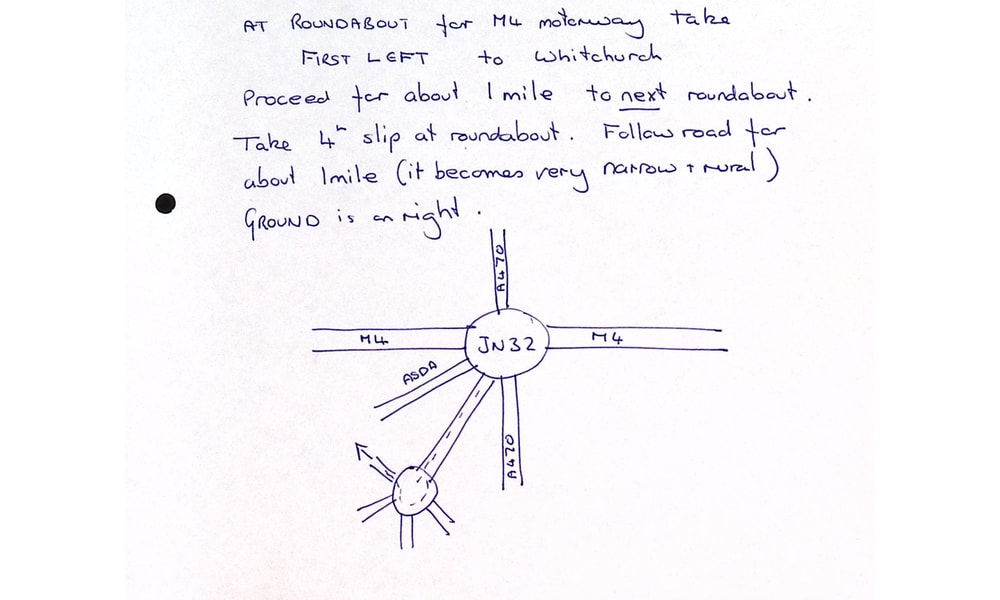
Seeking a host city with several rugby grounds and cheap accommodation, Griffin wrote to clubs and universities across England and Wales. Talks advanced with Leicester and Bristol before the organisers decided on Cardiff. The competition would be held over nine days, 6th - 14th April 1991.
Rugby administrator Vernon Pugh encouraged clubs to host matches and the Arms Park was made available for the final. The Sports Council for Wales also showed enthusiasm: they helped to secure use of the university accommodation and offered access to the National Sports Centre - with its gym and training pitches - as a base for the organising committee. Cardiff Council and South Glamorgan County Council were also supportive, while the Welsh Rugby Union helped source referees and sold tickets through its box office.
Image: Hand-drawn map issued to team chaperones
Notifying the IRFB
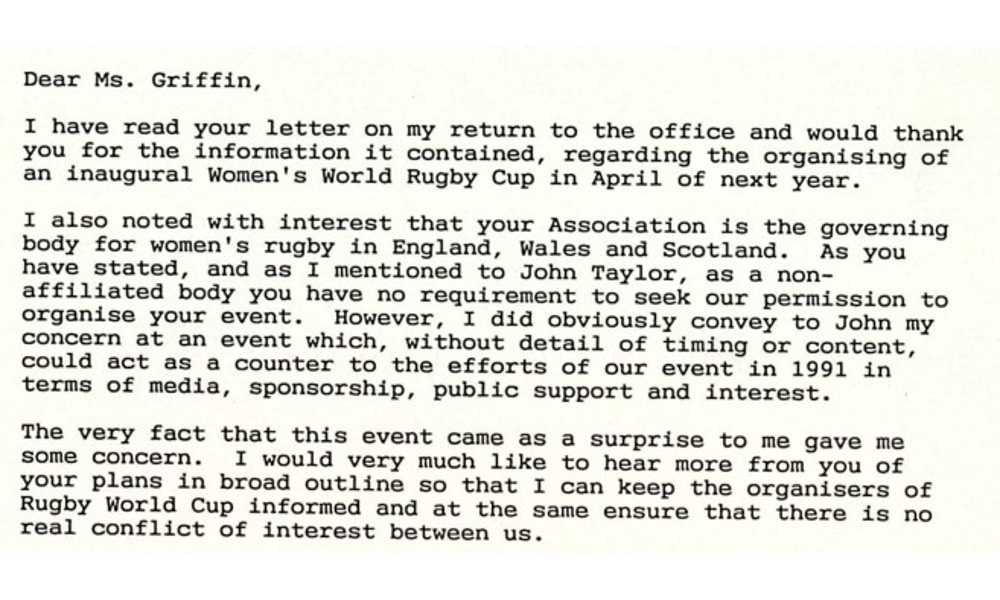
In August 1990, Griffin wrote to the Secretary of the International Rugby Football Board (IRFB), to request support for her plan. The IRFB did not need to give permission, but its approval could be beneficial in securing venues, participants and sponsors.
At that time, the IRFB was organising the men's Rugby World Cup tournament and they were struggling to secure their own sponsors, despite having a multi-million-pound broadcast deal in place. The IRFB was wary that the two events could end up competing for the same commercial and sponsorship opportunities, and asked Griffin to provide an outline of her plans, so as to ensure there would be no conflict of interest. It became clear that the IRFB would not officially endorse the women's tournament.
Image: Letter to Deborah Griffin from Keith Rowlands, IRFB Secretary, August 1990
Participants
The same month, the organisers sent invitations to fourteen teams around the world. At the time of the launch event on 27th November 1990, nine teams had confirmed their participation. The French team did not commit until the eleventh hour, notifying the organisers just minutes before the draw in February 1991.
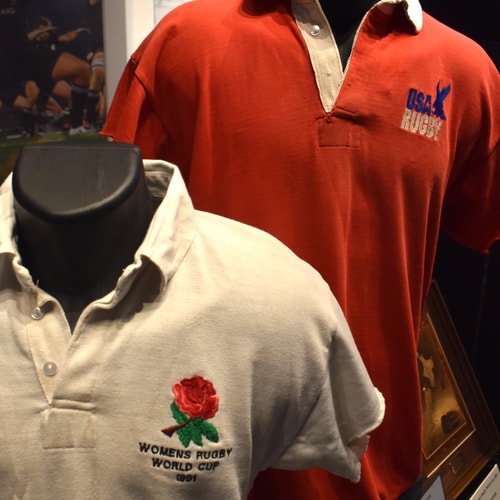
The eventual line up featured twelve teams - the USA, England, New Zealand, the Netherlands, Spain, Canada, Sweden, Wales, Italy, Japan, the Soviet Union and France. This allowed for a format involving four pools of three teams, with the winners of each group proceeding to the semi-finals.
Image: England and USA jerseys worn by Sue Dorrington and Val Sullivan, respectively.
Trophy
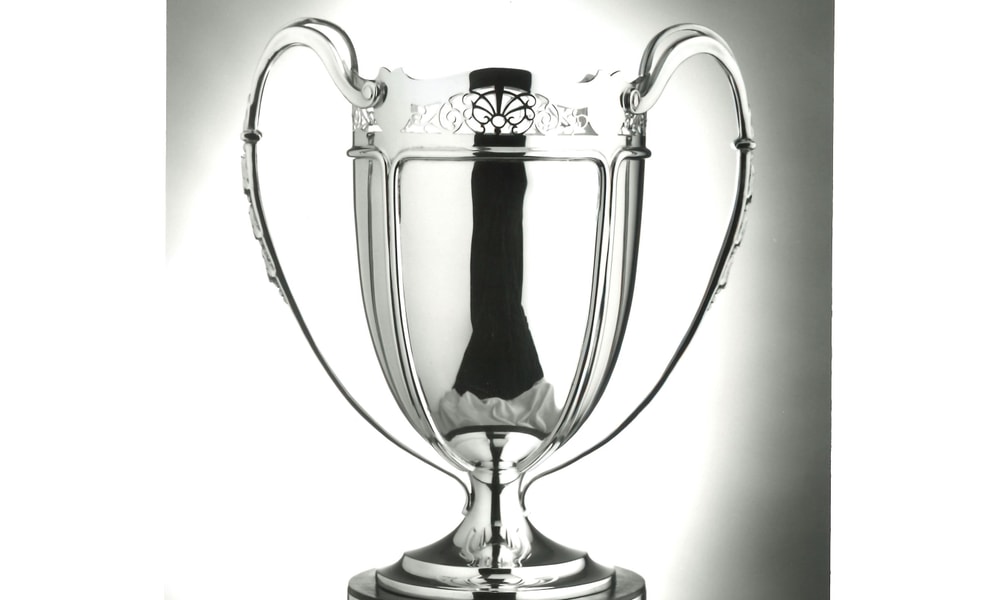
Sue Dorrington trawled the jewellers' shops of Hatton Garden looking for a suitable trophy. For £1000, she acquired a silver cup made by Birmingham-based silversmiths Adie Brothers in 1924. The Art-Nouveau-style openwork pattern around the rim gives it a delicate, almost lace-like quality that seemed more feminine than the other trophies available. Whilst aesthetically beautiful, a practical drawback was discovered when, having won it, the players were unable to drink out of it - the champagne kept escaping through the gaps.
At one stage, the organisers were hopeful that Princess Anne - who had expressed interest in the tournament - might present the trophy, but this did not materialise.
Image: Women's Rugby World Cup trophy, 1991-1994
Logo
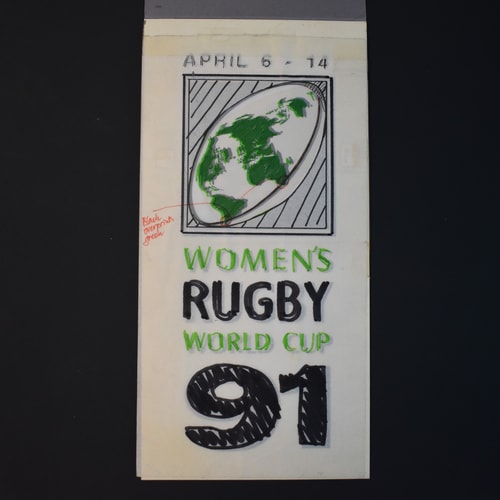
The competition logo was designed by Alice Cooper's cousin, James Young of January Design. The brief had been to avoid any confusion with the logo for the men's Rugby World Cup, but when the logo was launched, it was deemed unacceptable by the IRFB. The angle of the ball, the 'speed stripes' and the enclosure of the design in a box were considered too similar.
Having altered the design to include an image of the globe, the issue was raised again months later with the threat of legal action. Griffin was asked to meet with the IRFB, which not only took issue with similarities between the logos, but also the fact they were calling their event a 'Rugby World Cup'. Reluctantly, they agreed to revise the logo again but remained determined to keep the name. After seven weeks, the IRFB decided that the logo could be used after all. The hold-up delayed the production of tickets, programmes and merchandise, while redesign and reprinting costs ran to nearly £4000.
Image: Logo design by James Young, 1990
The struggle for sponsorship
The organisers sought a basket of sponsors contributing £25,000 each and shortlisted 24 companies to contact, hoping to win them over with branding opportunities, match tickets and hospitality packages. All the companies politely declined. Undeterred, they decided to recruit a sponsorship agent, John Taylor International (JTI).
The organisers were optimistic that a broadcast deal would attract sponsors, but confirmation of television coverage came too late. Despite the best efforts of JTI, who approached around 600 companies, no sponsors were found. Griffin was forced to contact the participants and tell them they could not be given any financial support. The teams all replied to say they would still be coming to Cardiff.
Television and press coverage
A few weeks before the tournament kicked off, the producer of Rugby Special agreed to air two packages on the BBC and BBC Wales - a feature on the event and coverage of the final, 'duration depending on the quality of the match'.
Some journalists approached the women's tournament with incredulity, while others demonstrated genuine support. David Hands of The Times and Stephen Jones of The Sunday Times were particularly supportive. As Press Officer, Alice Cooper was their primary point of contact. A room at the National Sports Centre served as the Press Office - with no windows or air conditioning, it became known as 'the bunker'. Initially worried that the phone might not ring at all, she ended up fielding calls from dawn until midnight every day of the tournament, such was the interest generated.
High-quality rugby
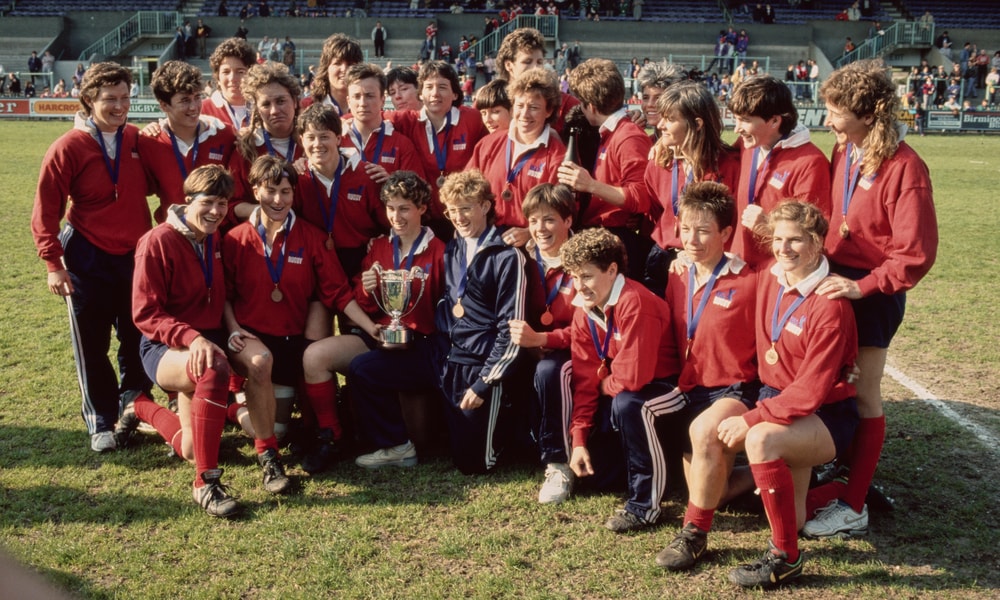
Despite scepticism from some, the standard of rugby was spectacular and the press reports were glowing. The particularly impressive USA team dominated on the field, but they were not the only ones to win fans. The Japanese team had never played a Test match before and they left the tournament without scoring a point, but they won hearts by bowing to opposition scorers. Of course, not everything went according to plan - three days before the final, the England team found themselves sleeping on the floor of a conference room after their hotel rooms were double booked.
Around 3000 spectators attended the final, contested by England and the USA at Cardiff Arms Park. Captained by Mary Sullivan, the USA team had bulldozed their way to the final with their 'locks from Hell' and 'turbo props'. However, England - led by fly-half Karen Almond - demonstrated greater technical ability, even going 6-0 up in the first half. The USA got points on the board with a kick from Chris Harju and then proved unstoppable, scoring 16 unanswered points in the second half to win 19-6.
Volunteers were assigned to chaperone each team, accompanying them to matches and hospitality functions, and liaising between the team and the various organisers and officials. Behind the scenes, the organisers worked all hours. Alice Cooper stayed up until 2am typing match programmes, then woke at 7am to get them to the printers. As Event Manager, Griffin worked similar hours, typing reports and instructions in her bedroom at the National Sports Centre.
Image: USA team, 1991
Finances
With treasurer Mary Forsyth looking after her newborn baby, Isla Nicholson handled the finances during the tournament. The organisers had been forced to cut costs wherever possible, but gate receipts were lower than expected and the failure to attract sponsorship was a major blow. They were left needing £17,567 to break even.
Costs run up by the Soviet Union team had contributed over £4000 to the debt. Unable to leave their country with hard cash, they arrived with no funds for accommodation, transport or food. England flanker Carol Isherwood and Helen Ames of the WRFU drove a minibus to Heathrow airport to collect the team, and discovered that their luggage contained vodka, caviar and souvenirs which they planned to barter in exchange for funds. Customs Officers soon put a stop to this and local businesses stepped in to provide meals and transport, but the team's accommodation costs still needed to be paid.
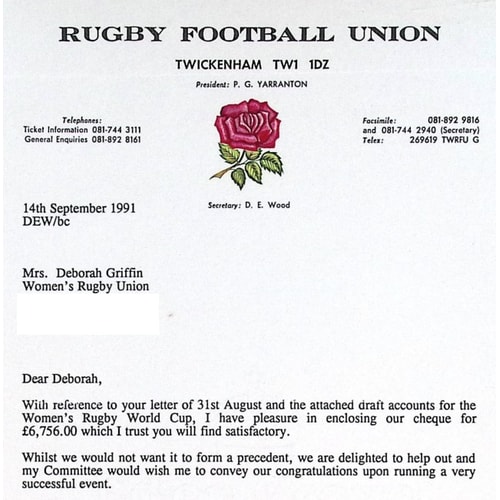
Griffin and her team were left to foot the bill for a number of costs and it was rumoured that they would be forced to remortgage their houses. Seeking assistance with the debt, Griffin sent draft accounts to the RFU and the Sports Council in May 1991. JTI agreed to halve their bill and the Sports Council - which had contributed a £5,000 grant in advance of the tournament - issued a further £5,000. By August, there remained £6,756 to pay and the RFU quietly paid the deficit in a form of tacit support for the women's game.
Image: Letter to Deborah Griffin from Dudley Wood, RFU Secretary, September 1991
Legacy
Following a celebratory dinner held at the National Sports Centre and funded by the local council, the teams went their separate ways. Some of the tournament organisers woke up the next day, drove for three hours and went straight back to work.
The International Rugby Board would not recognise the tournament as an official Rugby World Cup for almost twenty years. Nonetheless, it laid the foundations for the future of the women's game. In conjunction with the tournament, Carol Isherwood organised a coaching conference exploring 'The Way Forward' for women's rugby, and several women who participated in the tournament subsequently took up roles in their national unions, organising and promoting women's rugby.
The next Rugby World Cup tournament in 1994 also relied on volunteers and contributions from the participants, but the perseverance of the women's rugby community paid off. The IRFB took over stewardship of the tournament and the 1998 iteration was the first to be officially sanctioned.
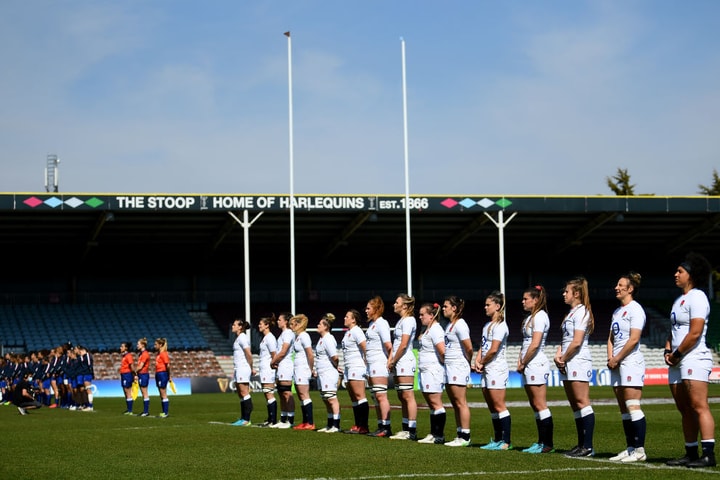
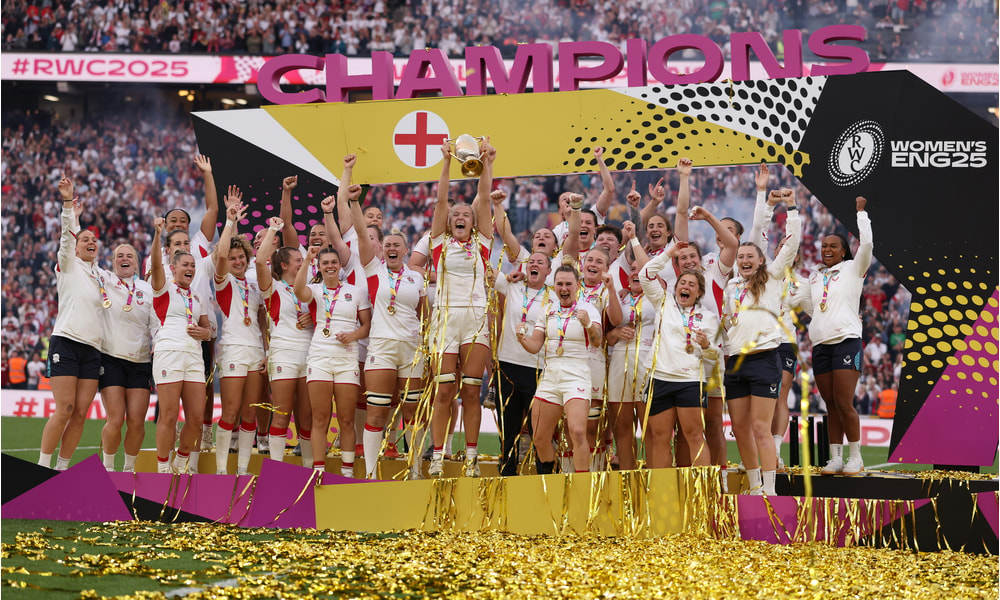
Deborah Griffin was named RFU President for the 2025-26 season, the first time a woman has held the post. During her tenure, England hosted the biggest women's Rugby World Cup tournament yet, with matches broadcast live and valuable sponsorship deals in place. It was the fastest-selling edition of the tournament so far, with Allianz Stadium, Twickenham, sold out for the final. But it was Griffin, Cooper, Dorrington and Forsyth who paved the way. Supported by a team of determined volunteers and motivated by the enthusiasm of the women's rugby community, they worked tirelessly to bring their game to the global stage.
Image: Red Roses, 2025
Pioneers: The First Women's Rugby World Cup ran at the World Rugby Museum from July 2025 to September 2026.
Related Articles